info@wolsports.com
0086 132 8323 3443
Factory price pilates equipments

info@wolsports.com
0086 132 8323 3443
Factory price pilates equipments
A programme director in Manchester sent me her equipment list last month. Nine trainees, one teaching room, forty weeks to the first exam. The list had eight reformers on it and nothing else.
I asked what the trainees would practise on in week six, when the repertoire moves to the tower and the chair. There was a long pause, then an email with a revised budget.
Training schools come to us with the same blind spot. The reformer gets bought first because it is the machine everyone recognises. Everything else gets planned later, and later usually means badly.
Here is how I would equip a certification programme from scratch, in the order that keeps a teaching room honest.
In a group class, nine clients can share one machine type for fifty minutes and nobody misses anything. In a training programme the same nine people have to learn the whole apparatus repertoire across two or three years, and they have to demonstrate it.
That changes the shopping list. A teaching room needs reformers for the classical progressions, one cadillac for tower and trapeze work, a chair and a barrel for the rest of the repertoire, and floor space for mat and standing work.
Schools that delay the cadillac end up teaching suspension work from photographs. Trainees memorise the shape of an exercise without ever feeling the springs behind it. That gap shows up in their first teaching job, not in the exam.
The ratio most schools settle on is two trainees per reformer. One works, one watches and cues, then they swap. Nine trainees means five machines in use, plus a sixth kept as a spare so a stuck carriage does not cancel a Friday session.
Do not round down and run shifts. A trainee who spends half the session watching learns half the cueing, and cueing is the part of the certification that clients actually pay for.
Our commercial reformer range covers the sizes that fit a teaching floor, from a 2.3 m studio frame up to the long carriage builds used for advanced work. Ask for the spec sheet before you count stations, because two models that look identical in a photo can differ by 15 cm of travel.
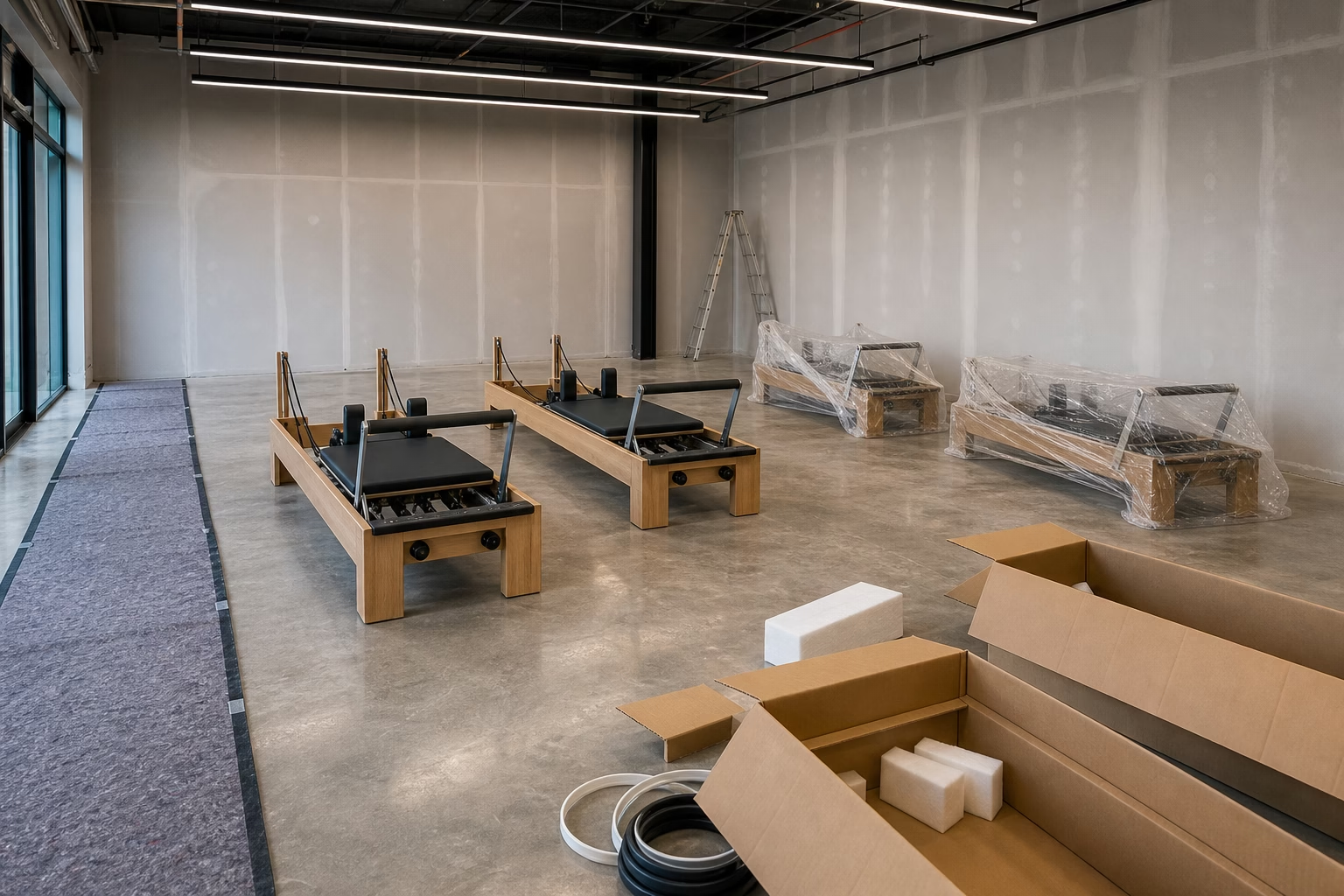
Buy the same model for every station. Same spring set, same footbar, same carriage height, same upholstery.
This sounds like a purchasing detail. It is a teaching decision. If two machines in the room resist differently, trainees learn that the equipment is unpredictable, and they start compensating with their hands instead of their eyes. A trainee who has practised on one consistent reformer can walk into any studio and read a new machine in ten minutes.
The same logic applies to the cadillac. One well-specified unit teaches more than two mismatched ones. Our maple cadillac reformers are built on the same rail and spring system as the reformer line, so the spring colours and the push-pull feel carry across from one machine to the other.
A studio buys reformers to run classes back to back. A school buys them to be looked at, adjusted and explained. Four specifications matter more than the rest.
Carriage height. Low enough that a trainee standing beside the machine can see the client pelvis without bending double. If the instructor has to crouch to check alignment, the machine is wrong for teaching.
Carriage width. Wider carriages give room for spotting and for larger clients. Schools rarely regret the wider option.
Spring range. A five-spring layout with clear colour coding is easier to teach than a six-spring layout with narrow increments. Trainees need to feel the jump from light to medium before they can explain it.
Upholstery colour. Pale vinyl photographs well and shows every handprint. Mid-tone greys and olives survive a teaching room, where machines get adjusted forty times a day by people still learning where to put their hands.
Every school should receive a spec sheet per model, a parts list with part numbers, a spring set list showing colour and resistance, an assembly video, and written warranty terms that survive commercial use.
Ask for a spare spring set with the first order. Springs fatigue, and a school with nine trainees will notice a soft spring long before a class studio does, because trainees practise the same transition for an hour at a time. Replace springs in sets, never one at a time, or the machine develops a bias that nobody can explain.
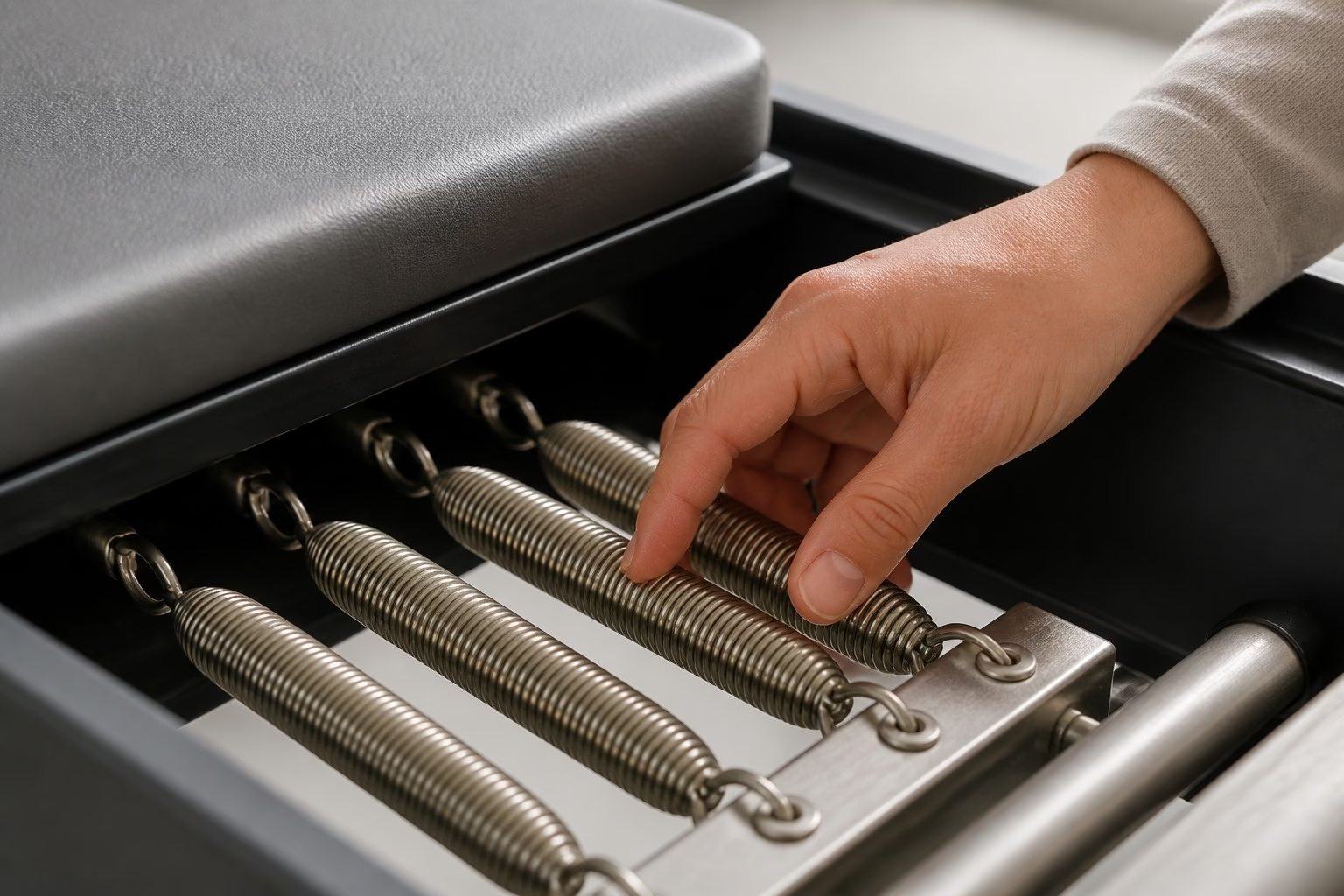
Wave one is the reformers, the spare springs, and the small parts that stop a session: straps, ropes, a spare footbar pad. Wave two is the cadillac, chair and barrel, ordered once enrolment is stable and you know how many trainees you are actually teaching.
Do not buy everything at once to save one freight bill. A school that spends its whole budget on wave one and has no reserve for the tower will teach a truncated syllabus for a year, and the syllabus is the product.
Home-grade machines on a commercial timetable. A home reformer rated for two sessions a week will not survive nine trainees practising daily. The warranty usually excludes commercial use, so the first failure is also the last covered repair.
No spare springs. The cheapest item on the order and the one that stops a class.
Cadillac last, forever. It gets pushed to next year because the reformer budget already hurt. Then the tower module gets taught on video.
Mixed models from mixed suppliers. Two brands means two parts inventories, two spring systems and no shared spares.
No delivery plan. Six crated reformers at 245 cm each need a loading dock, a goods lift or a wide stair. Check the route before the container ships, not when the truck is at the kerb.
Trainee numbers per intake, the room dimensions, whether the floor is ground level or above, and the apparatus your syllabus covers. With those four things we can size the order and tell you which crate configuration fits the building.
Send the syllabus too. It is the fastest way for us to spot the machine a school forgot to budget for.
Send your trainee numbers, room plan and syllabus. We will recommend the reformer count, the cadillac specification and a two-wave budget that fits your intake.

