info@wolsports.com
0086 132 8323 3443
Factory price pilates equipments

info@wolsports.com
0086 132 8323 3443
Factory price pilates equipments
A studio owner in Melbourne sent me photos of a spare room last month. Four point two metres by three point six. She had quotes for five reformers and a class schedule already half sold. Her question was blunt: “Can I run a real studio on folding machines, or am I about to buy props?”
I have walked through enough factory floors and enough badly planned studios to answer that honestly. A foldable pilates reformer can be genuine commercial equipment. It can also be a £700 folding bed with springs bolted on. The difference sits in three places: the hinge, the rail section, and how the frame behaves after a thousand open-and-close cycles.
Almost every folding reformer sold today hinges at the middle of the rail. The head end lifts, the foot end stays put, and the machine lands at roughly half its working length. A standard 235–245 cm frame becomes something closer to 120–130 cm when folded and standing.
Folded height and folded depth matter more than folded length. Buyers focus on length because it is the number in the brochure. Storage is a volume problem. A machine that folds to 125 cm but leaves a 60 cm deep footprint and cannot stand upright still eats the wall you were trying to save.
Ask for three numbers before you sign anything: folded length, folded depth, folded height when standing on its end. If a supplier cannot give you all three with a tape measure photo, they have not tested their own product.
Not everyone. I talk buyers out of folding frames about as often as I recommend them.
Folding makes sense when the room has a second job. Dance studios that run reformer classes on Tuesday and workshops on Thursday. Physio clinics that need floor space for assessment. Hotels and corporate wellness rooms where the reformer lives against a wall nine days out of ten. Home studios in apartments where the living room has to be a living room again by seven in the evening.
Folding makes much less sense for a dedicated boutique studio running eight classes a day. You will fold the machine twice in its life. You are paying for a hinge you never use, and you are accepting a small stiffness penalty in the rail that a fixed frame does not have.
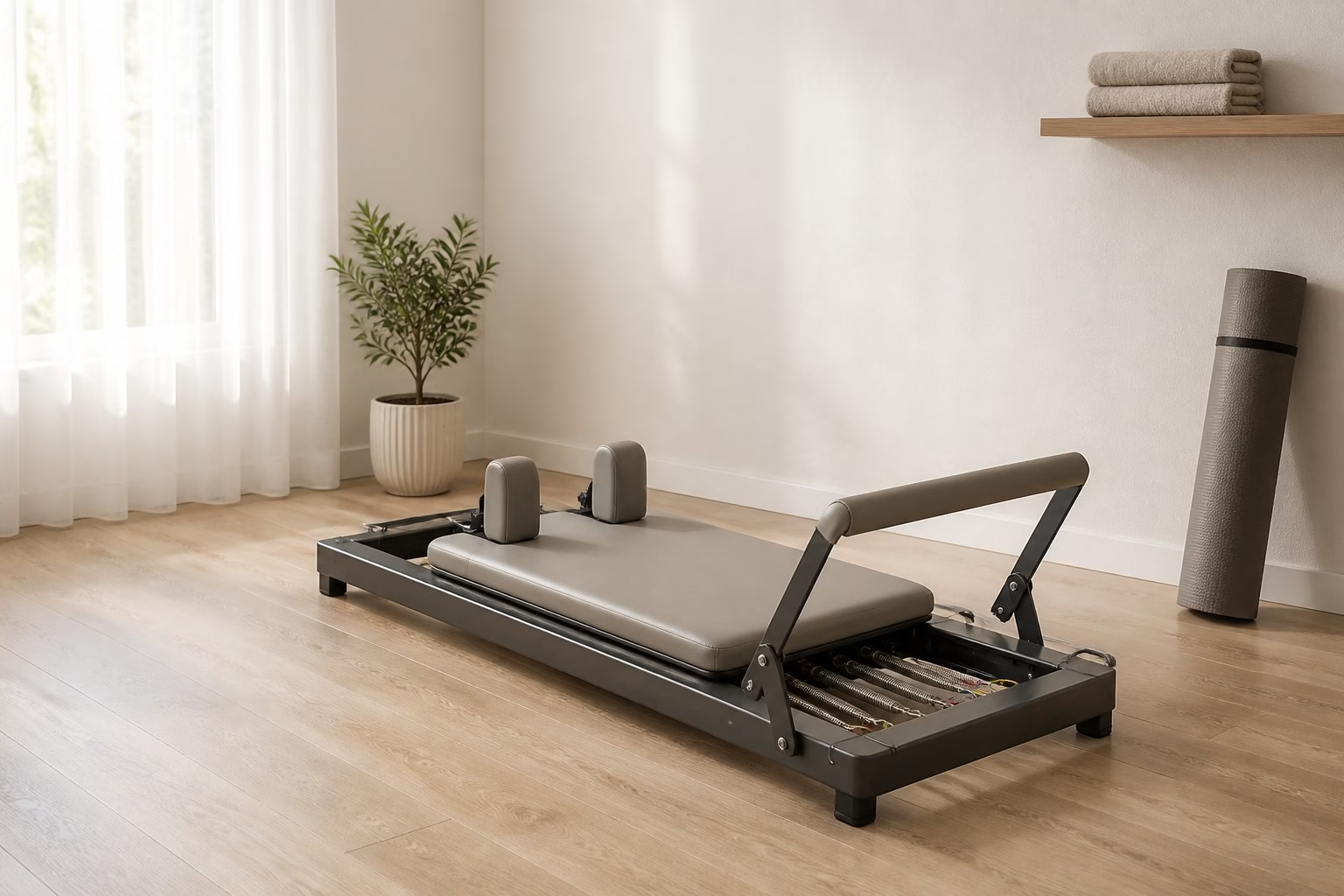
On a good folding reformer, the hinge is a machined block with a steel pin, a locking collar, and a positive stop. When it locks, you should feel one movement and hear one click. No rock, no second settling motion.
Here is the test I run on a sample before approving a production batch. Set the machine up, lock it, then push down hard on the foot bar end and pull up on the head end. Watch the joint. Any visible gap change means the pin is undersized or the block is aluminium that has not been heat treated.
Then fold and unfold it twenty times in a row and check whether the carriage still runs clean through the joint. If the rails shift even half a millimetre, the carriage wheels will start to catch within a few months of daily use. That is when studios call me asking about replacement wheels that do not exist for their model.
Most suppliers quote a frame warranty and stay quiet about the joint. Ask directly. A supplier who offers three years on the frame and twelve months on the hinge is telling you something useful about their own confidence.
Aluminium wins on weight and humidity. A folding aluminium reformer typically lands around 45–60 kg, which one person can move on casters and two people can lift onto an end. In coastal studios, unheated gyms, and anywhere the machine sits near a pool or a shower block, aluminium will not swell or delaminate.
Wood wins on feel. Maple and beech frames absorb sound, look warmer in a boutique studio, and many instructors prefer the vibration character under load. The trade-off is weight and moisture sensitivity. A folding maple frame is heavier at the hinge, so the joint carries more stress every time the machine is moved.
Our own aluminium foldable reformer is the model I recommend for hotels, clinics and multi-use rooms. The maple wood foldable reformer suits boutique studios that fold occasionally and care about the finish. Both share the same hinge architecture, which is deliberate — I do not want two different joint designs in the field.
This is the part most buyers underestimate. Folding changes volumetric weight, and volumetric weight is what you pay for on a pallet.
A fixed commercial reformer crated for export typically occupies around 0.45–0.55 cbm. The same machine in folding form crates at roughly 0.30–0.35 cbm because the crate gets shorter. On an LCL shipment of ten units, that difference is often the gap between one pallet position and two.
If you are still working out how many machines fit in a container, the maths changes again with folding frames. I keep a separate calculation for that in our container loading guide, because the answer is not simply “more”.
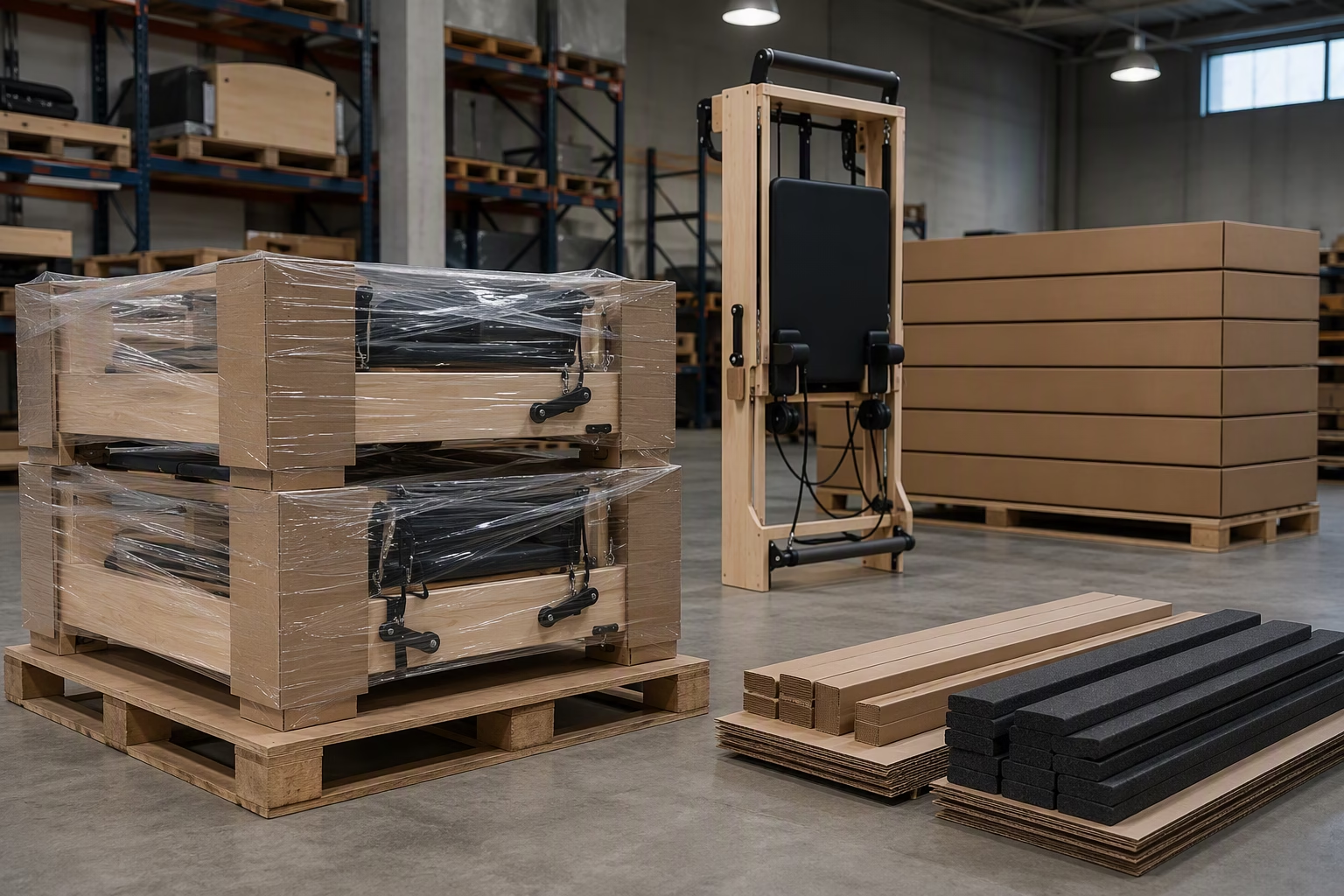
Three failure patterns show up again and again.
Buying home grade for commercial hours. A folding machine rated for two sessions a week will not survive twenty. The spring bar mounts and the carriage wheels are the first casualties, and neither is usually stocked as a spare part.
Assuming folding means light. Some folding frames are heavier than fixed frames because the hinge block adds mass. Check the shipping weight, not the marketing weight.
Forgetting the accessories. A jump board, a box, or a tower does not fold with the machine. If your storage plan depends on a clean 130 cm footprint, the box has to live somewhere too.
Start with one sample. Not five. Set it up in the actual room, fold it, stand it against the wall, and teach one class on it. Pay attention to noise from the joint under load and to whether the carriage tracks straight after folding.
Then order the rest against the same production batch, with the hinge specification written into the purchase order. Ask for the folded dimensions on the packing list so your freight forwarder quotes the right volume.
If you are comparing frame types before you commit, our size guide covers carriage travel and room clearance, and the reformer range shows the fixed and folding options side by side.
Send us your room dimensions, class size and target price. We come back with a spec sheet, the folded footprint in millimetres, and a loading plan for your container.

