info@wolsports.com
0086 132 8323 3443
Factory price pilates equipments

info@wolsports.com
0086 132 8323 3443
Factory price pilates equipments
Last month a studio owner in Rotterdam sent me her equipment list before she signed it. Eight maple reformers, forty springs, two towers. In the margin she had written one line: “Do I add a jump board to all eight?”
I asked how she planned to fill her timetable. She had three formats in mind and a room that could hold nine machines.
That is the right order to think in. Accessories are not decoration. Each one buys you a class format, and a class format either sells or it does not. So before you put jump boards on every carriage, decide which formats you are actually going to teach.
Most first-time buyers treat accessories as part of the machine price. They are not. On a factory order, accessories are usually quoted separately because they are packed separately, shipped by volume, and made in different batches.
Three Pilates reformer accessories come up in almost every studio conversation I have: the jump board, the sitting box and the platform extender. They cost a fraction of a reformer each, and together they can change how a room feels to clients.
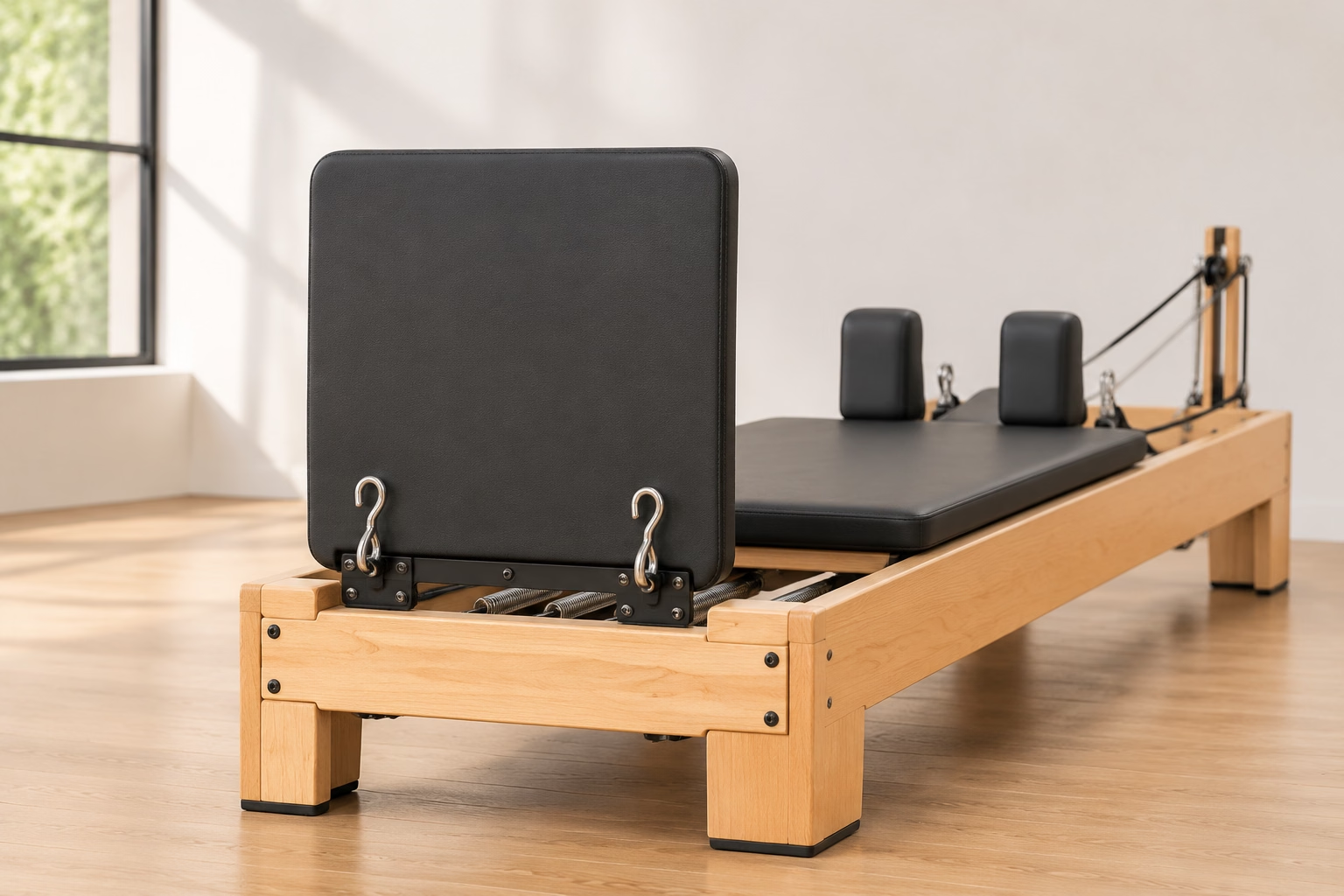
A jump board replaces the foot bar with a padded vertical panel. The client lies on the carriage, puts their feet on the board, and pushes off. Springs pull them back. It is jumping without landing on a hard floor.
What it gives you is a cardio and coordination format that still looks like Pilates. Instructors use it for bone density work, for athletes who need plyometric load, and for clients who want to sweat without a treadmill.
What it costs you is space and noise. Jumping on a carriage is louder than sliding on it. On a timber second floor, that matters more than the board itself. If the studio is above a neighbour, read our notes on reformer noise and vibration before you order eight of them.
Firm boards and trampoline-style boards are not the same product. A firm padded board gives a large, stable landing surface and suits heavier clients and controlled work. A tramp board is springier and reduces impact, but the landing area is smaller and the feel is less predictable under a beginner. Most commercial studios I supply choose firm.
Common factory sizes run from about 21 to 29 inches wide and around 20.5 inches deep. Width should match the carriage and the shoulder rest position, not the other way around.
A wooden box, usually upholstered on top, that sits on the carriage. Around 23 by 16 inches in most studio versions, with a rated load that should be printed on the spec sheet.
Put it on the carriage and you get prone work, seated work, side-lying work, and a stable platform for short box series. Take it off and the same machine does something else. No other accessory changes a class plan that much for that little money.
Two details decide whether a box is good or annoying. The first is foam density. Soft foam feels generous in the showroom and collapses in month eight. The second is the base. A box that slides on the carriage during a roll-down is a box your instructors will stop using.
We fit a non-slip base and a firmer foam on the studio boxes that ship with our maple wood reformers, because the box gets used in almost every class.
The extender bolts onto the standing platform at the head end of the reformer. It roughly doubles the usable surface, which turns a narrow standing area into something a client can kneel on, stand on with both feet, or lie across.
This is the accessory that makes standing work safe. Without it, a taller client standing on a standard platform has very little margin. With it, you can run standing leg work, kneeling lunge series, and supine variations that need a longer base.
It also adds length. Measure the delivery route and the storage wall again after you add one, because a reformer with an extender no longer fits the same footprint.
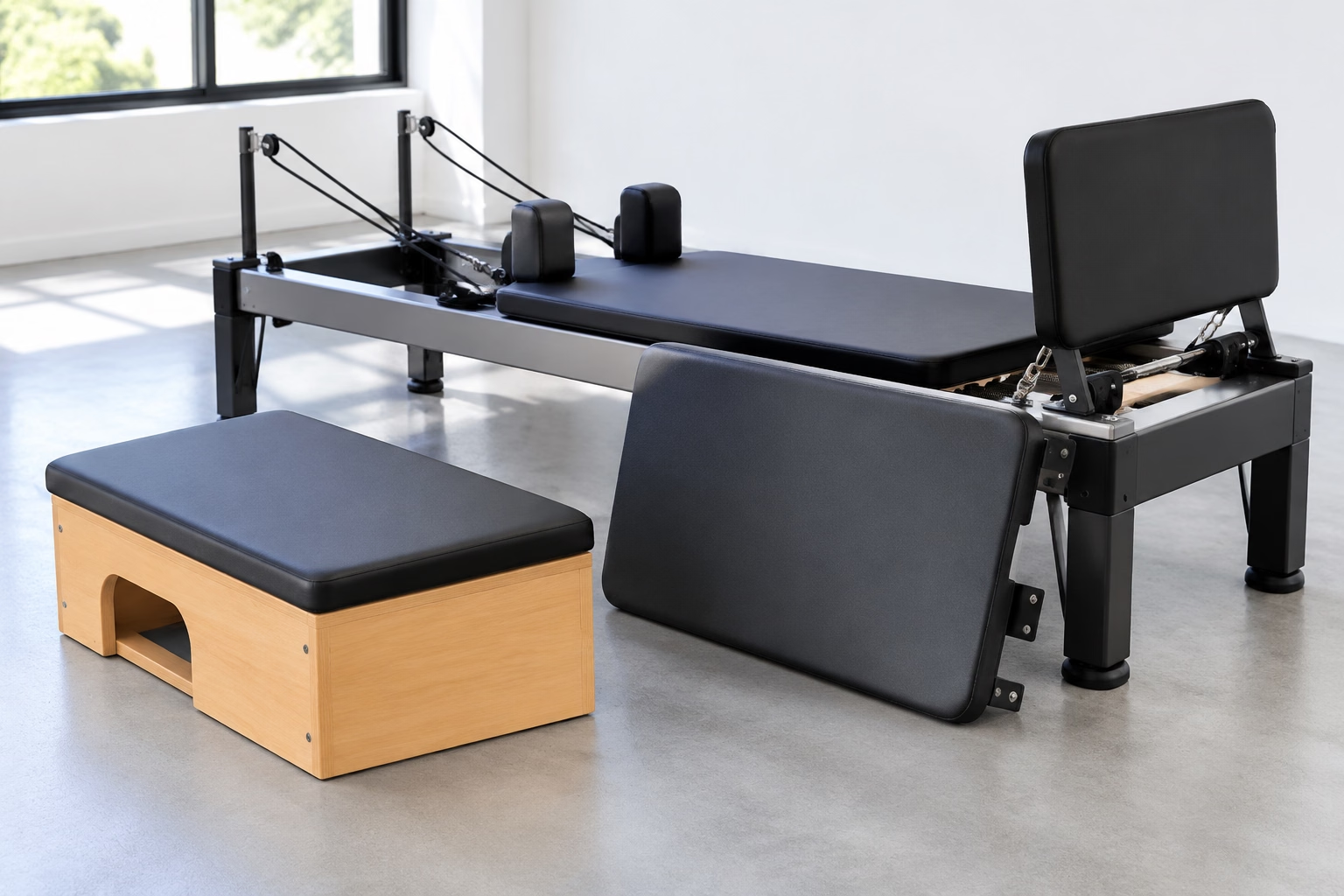
My default ratios for a studio running mixed formats:
| Accessory | Ratio | Why |
|---|---|---|
| Jump board | 1 per 2 to 3 reformers | Jump classes rotate through the room; not every machine needs one every hour |
| Sitting box | 1 per reformer | Used in almost every class, and carrying boxes between machines wastes changeover time |
| Platform extender | 1 per 4 to 6 reformers | Only needed for standing formats and taller clients |
A ten-machine studio that teaches one jump class a day does not need ten jump boards. It needs three or four, plus a rule about which machines get them. A studio that sells jump classes as a signature format is a different calculation, and then one per machine is justified.
Boxes are the exception. Buy one per machine. The alternative is an instructor hunting for a box while nine clients wait on their carriages.
Every accessory on every machine. It ties up cash in items that sit against the wall for eleven months, and it makes your first order heavier and more expensive to ship.
Cheap boxes that do not match the carriage width. A box that overhangs or sits loose is a liability during fast transitions.
Tramp-style boards as a first purchase. They are a legitimate product, but they suit a specific class style. Learn how your clients jump before you commit the room to a springier surface.
Order one: boxes for every machine, plus two jump boards and two extenders. That covers the formats most new studios actually teach in the first six months.
Order two, once the timetable is full: more boards for the machines that run jump classes, and extenders for the machines used by taller clients.
If you are still deciding on frames, a foldable aluminum reformer with a box and one board often makes more sense for a small room than a fixed frame with no accessories at all.
Do accessories fit any reformer? No. Mounting points differ between frame series and between factories. Buy accessories with the machines, or ask for the bolt pattern before you order separately.
Can one jump board serve several machines? Yes, if your class schedule allows swapping. It takes under a minute to fit one, but it takes a minute you do not have during a changeover.
Is a sitting box safe for heavier clients? Only up to its rated load. Check the figure on the spec sheet, and check it against your heaviest client rather than the average.
Do accessories ship inside the reformer crate? Usually not. They are cartoned separately, which affects the container count and the unloading plan.
Send us your machine count, frame series and the formats you plan to teach. We will come back with a recommended accessory split, packing weights and a landed cost estimate for your port.
More on sequencing a studio build sits in our studio setup guides.

