info@wolsports.com
0086 132 8323 3443
Factory price pilates equipments

info@wolsports.com
0086 132 8323 3443
Factory price pilates equipments
Last Tuesday a studio owner in Portland sent me her floor plan. 1,300 square feet, one long room, windows down one side. Her question was short: “How many reformers can I fit?”
I asked for her class schedule instead. She thought I was dodging the question.
I wasn’t. The room tells you the maximum number of machines that will physically fit. The schedule tells you the number you should actually buy. Those two numbers are rarely the same, and the gap between them is where most studio budgets go wrong.
Every reformer in your studio produces a fixed number of “spots” per week. One machine, one class, one body. That is the unit of capacity you are buying.
Here is the arithmetic I run with buyers before they see a quote.
A 50-minute class with a 10-minute changeover gives you one class per hour. Six classes a day, six days a week, is 36 classes. Multiply by the number of machines and you get weekly spots.
| Machines | Classes/week (6/day, 6 days) | Weekly spots | Visits at 65% fill | Members at 2 visits/week |
|---|---|---|---|---|
| 6 | 36 | 216 | 140 | 70 |
| 8 | 36 | 288 | 187 | 93 |
| 10 | 36 | 360 | 234 | 117 |
| 12 | 36 | 432 | 281 | 140 |
Read that table backwards. If your membership plan says 90 active clients who train twice a week, you need roughly 180 visits of capacity. Eight machines will do it. Twelve will sit half empty on a Tuesday morning and you will still be paying for them in year three.
I use one rough benchmark with the dealers and studio owners we supply: hold your fleet at around 70% average fill across the week.
Below 55%, you bought too early. The machines are fine, the schedule is not full enough to pay them back, and every extra unit pushes your break-even month further out.
Above 80% for more than a month, you are leaving money on the floor. Clients who cannot get a 7am slot do not wait. They find another studio and they usually stay there.
A waitlist that runs two weeks deep is the clearest signal I know. At that point, add machines, add a class slot, or both.
New owners count class time and forget the ten minutes between classes. In a 12-hour day that is two hours of cleaning, wiping, spring checks and letting clients in and out. You cannot sell those two hours.
That is why 36 classes a week is realistic and 60 is a spreadsheet fantasy. Unless you run two instructors on two floors, the schedule caps out before the room does.
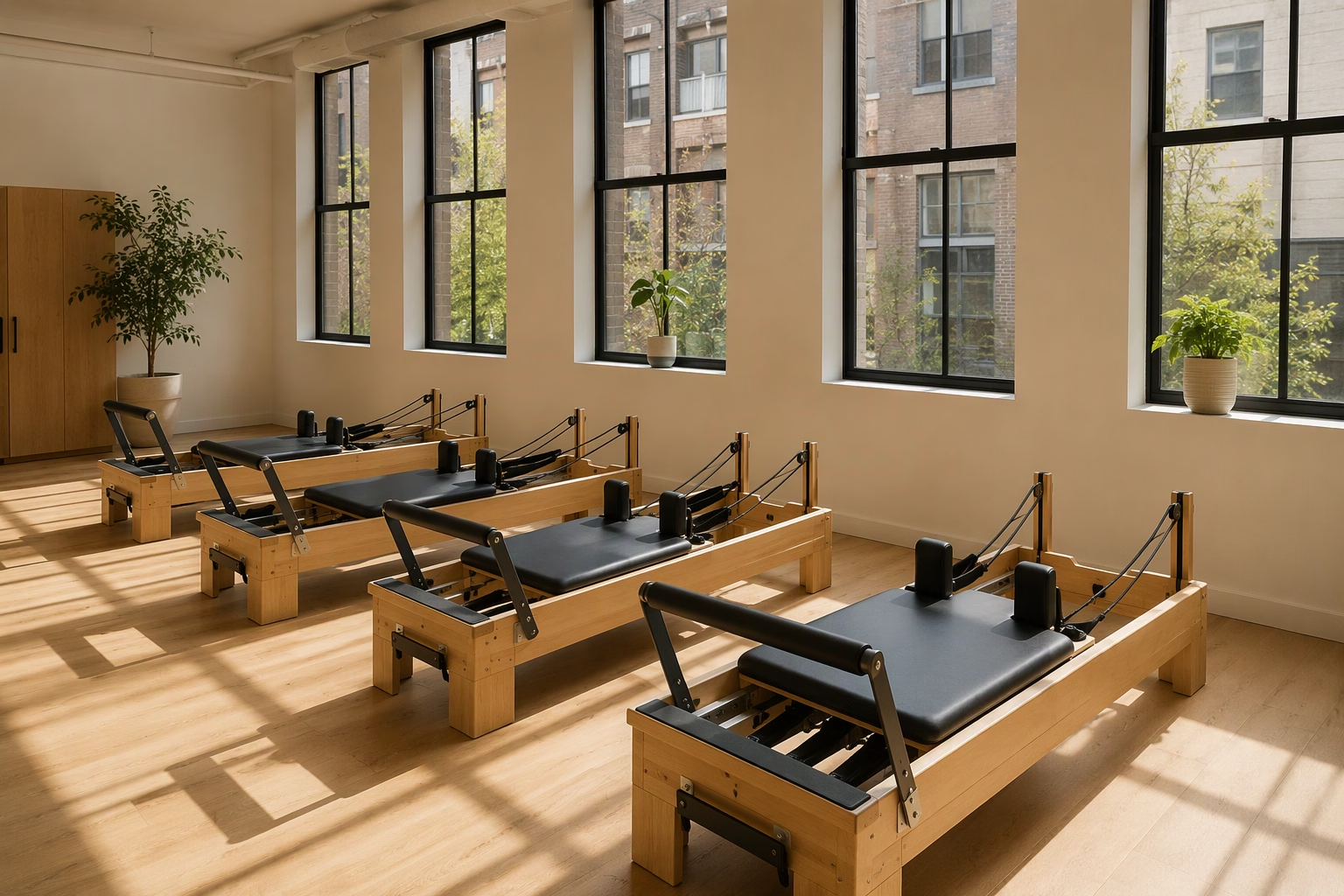
Once you know the count, check whether the room allows it. A standard commercial reformer runs about 244 cm long and 62 cm wide. A short or home model runs 210 to 220 cm.
Plan on at least 60 cm of clearance on each side of every machine. That is where clients stand, where instructors walk, and where you get to a spring without climbing over someone. In practice, budget 2.9 to 3.2 square metres per reformer once circulation is included.
Two things most floor plans miss:
If the room is tight, a foldable frame buys back floor area between classes. If the room is generous, buy footprint you can grow into rather than machines you cannot fill.
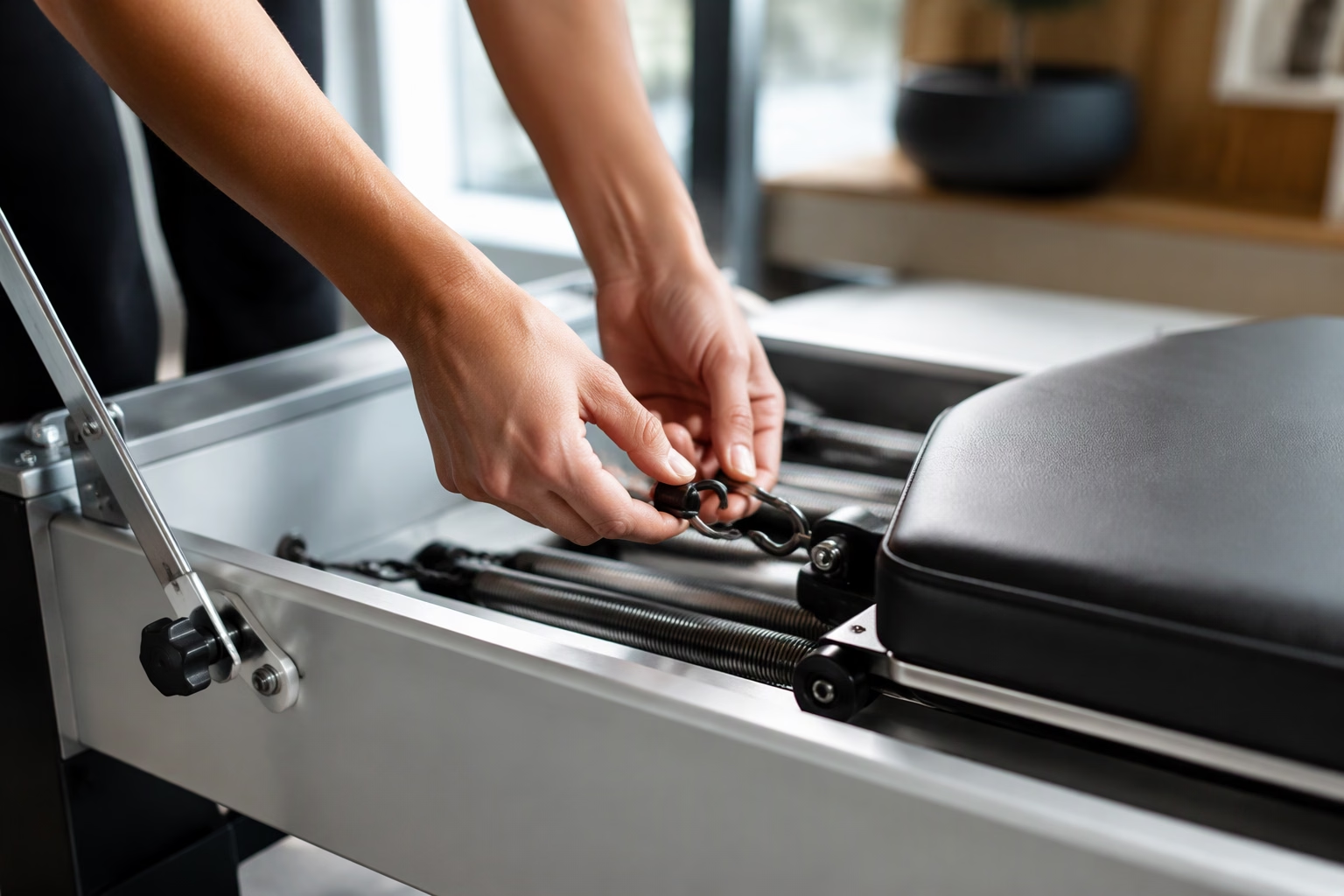
A uniform fleet is easy to run and boring to sell. My default for an eight-machine studio is six standard reformers plus two with towers. The tower pair covers semi-cadillac work, rehabilitation referrals and the clients who want something closer to one-to-one training.
For a studio adding a high-intensity format, count megaformer-style machines separately. They need 4 to 5 square metres each, they do not share the same class schedule, and they attract a different client. Do not assume a megaformer replaces a reformer slot in the plan.
Concrete models we ship for this kind of build-out:
My advice to almost every first-time buyer: order 70 to 80% of your target count now, and keep the remaining 20 to 30% as a planned second order once the schedule proves itself.
Two conditions come with that advice.
First, stay inside one frame series. If you buy six maple reformers this year and four from a different supplier next year, the carriages will feel different, the springs will pull differently, and your instructors will start assigning clients to specific machines. That is a headache you pay for every class.
Second, ask about batch consistency on upholstery. Vinyl and PU are dyed in batches. A reorder twelve months later can be a shade off, and in a room with ten machines, one off-shade carriage is the only thing anybody sees.
Can I add machines later and have them match? Yes, if you stay with the same frame series and ask the factory to match the upholstery batch. Send the original order number when you reorder.
Do I need one reformer per client in a group class? Yes. Reformer group classes are one machine per person. There is no sharing arrangement that works at pace.
How many for a home studio? Two or three. One for teaching, one or two for a partner or a small private group. Beyond three, a home room starts to feel like a gym floor.
What if I only have 900 square feet? Six machines with 60 cm clearances fits comfortably. That is 216 weekly spots, which supports roughly 70 members at two visits a week.
Write your class schedule first. Count the slots you can actually staff. Multiply by the machines you think you want. Then check whether that number of visits matches the membership you can realistically sell in your first year.
If the numbers line up, the floor plan will follow. If they do not, no amount of nice equipment fixes it.
Send us your class schedule, room dimensions and target opening date. We will come back with a machine count, a mix recommendation and a landed cost estimate for your port.
More on room planning and build-out sequencing sits in our studio setup guides.

