info@wolsports.com
0086 132 8323 3443
Factory price pilates equipments

info@wolsports.com
0086 132 8323 3443
Factory price pilates equipments
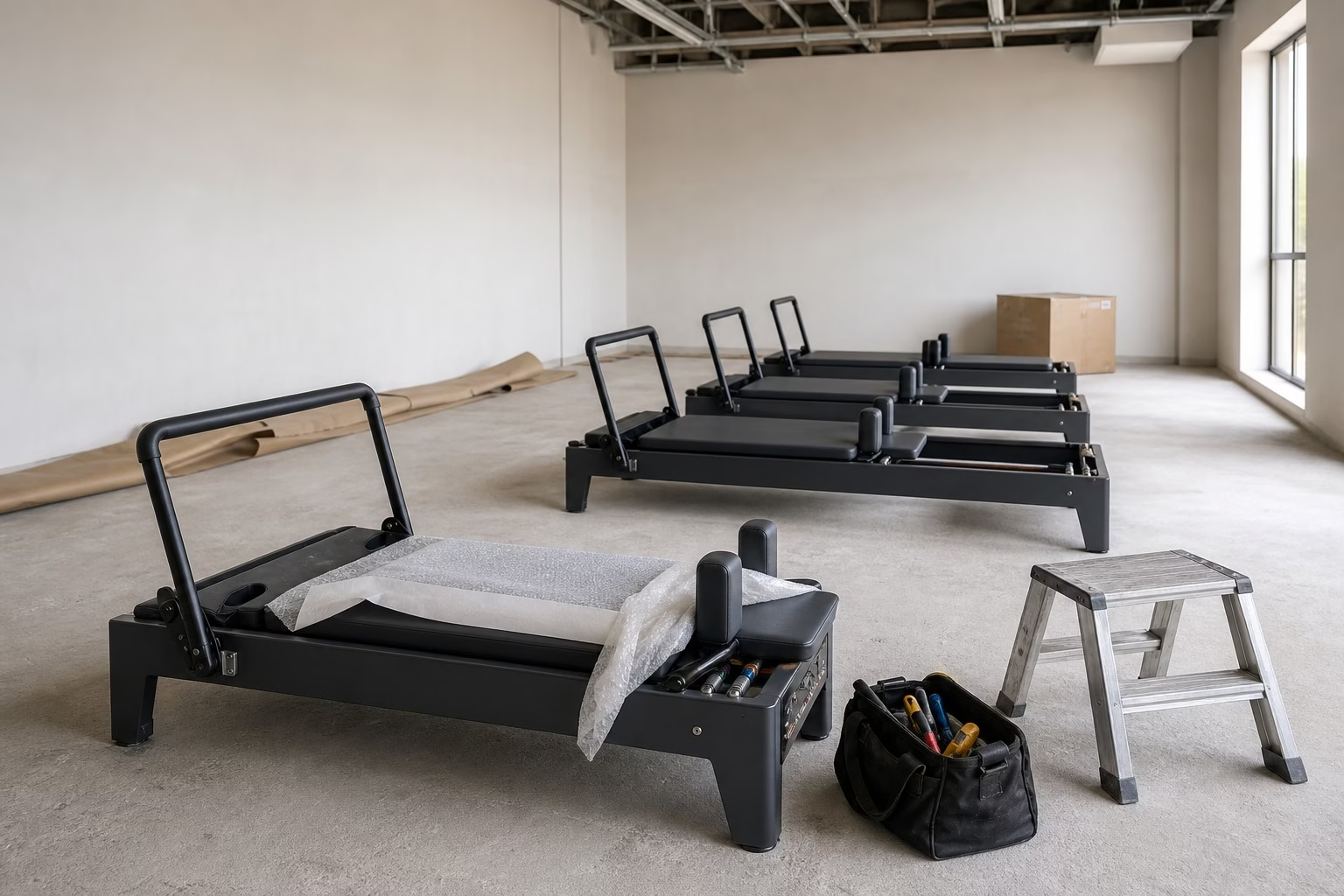
Two years ago a studio owner in Auckland did something sensible on paper. She bought her reformers from one supplier, her towers from a second, and the accessories, mats and boxes from a third because each one was cheapest at something. Three good decisions.
Then installation week arrived. The towers did not line up with the reformer frames. The upholstery colour she had ordered as “warm grey” arrived in two different warms. The mat area was measured for mats that were never in the plan. What should have been a ten-day fit-out took six weeks, and she opened a month late with a class schedule already sold.
I work on the supply side of this industry, and I hear a version of that story every month. Buying equipment is not the hard part. Assembling a studio that actually works — machines, layout, colours, freight, installation, spares — is the hard part. That is what one-stop supply is supposed to solve, and it is worth being precise about what that phrase really means.
Plenty of suppliers call themselves one-stop because they sell two product categories. That is not a studio solution.
A genuine one-stop studio supply covers the whole chain in one accountable place:
If any of those eight steps sits outside the supplier’s control, you are the project manager. That is the real risk. Not price. Project management you never signed up for.
Almost every mistake we get asked to fix started with a machine choice made before the room was measured.
Send the floor plan first. A landlord drawing, a rough sketch with dimensions, even a phone photo of a marked-up plan will do. From that we can tell you how many machines the room genuinely supports — which is almost always fewer than the number people hope for.
The number that catches owners out is walking space. A reformer row needs clearance behind it while a class is in progress. If you plan the machines wall to wall and ignore that gap, your six-machine studio becomes a four-machine studio after the first class.
From the plan we model two or three real layouts, not one. Typically: a row along the long wall, an L-shape for rooms with a corner, and a paired layout for narrow spaces.
Each option changes what you can teach. A row suits travelling work and long classes. Paired layouts suit private sessions and small groups. If you already know your class format, we can usually eliminate one option immediately and save you a week of deliberation.
This is where most studio owners finally relax. Seeing the room rendered — machines at true scale, walking gaps visible, storage and waiting space in place — changes the conversation from “I think this fits” to “this is the room”.
It also protects you. If the layout is wrong, we redraw. Changing a drawing costs nothing. Changing a loaded container costs a great deal.
Bring your floor plan and reference photos to a face-to-face meeting and this stage can happen on the spot. It is far faster than emailing drawings back and forth, and you can point at a problem instead of describing it.
Once the room is settled, the package falls out of it. A typical boutique studio lands on four to six reformers, one tower or cadillac for private work, and a mat area for warm-ups and cool-downs.
We quote this as one package rather than a shopping list — machines, accessories, spare parts and the drawing work in a single number. You can see the reformer range, the reformer-with-tower builds and the long-platform dynamic training machines we supply in that mix.
If you have a budget figure, give it to us at the start. It is much easier to design to a number than to cut a finished package down.
A studio is a brand. Frame colour, carriage upholstery, footbar type and logo plate are all standard customisation points on an order.
Two pieces of practical advice. First, sort the colourway before production, not after — re-upholstering a delivered row is expensive and slow. Second, ask for a physical swatch, not a screen image. Upholstery photographed on a monitor and upholstery under studio lighting are rarely the same colour.
The part clients never see is the part that decides whether opening day happens on time.
Ask any supplier three questions. When is the pre-shipment inspection, and will you send photographs? How many units fit in the container for this mix? What is the production lead time on a custom colourway as opposed to stock? A supplier who answers all three without hesitating has done this before.
Unloading and assembling a row is where small problems surface: a footbar that needs adjusting, a spring set that is too heavy for beginners, a carriage that needs a shim on an uneven floor.
Good suppliers stay on the phone through that week. We would rather spend an hour on a video call during your first classes than have you guess at a fix.
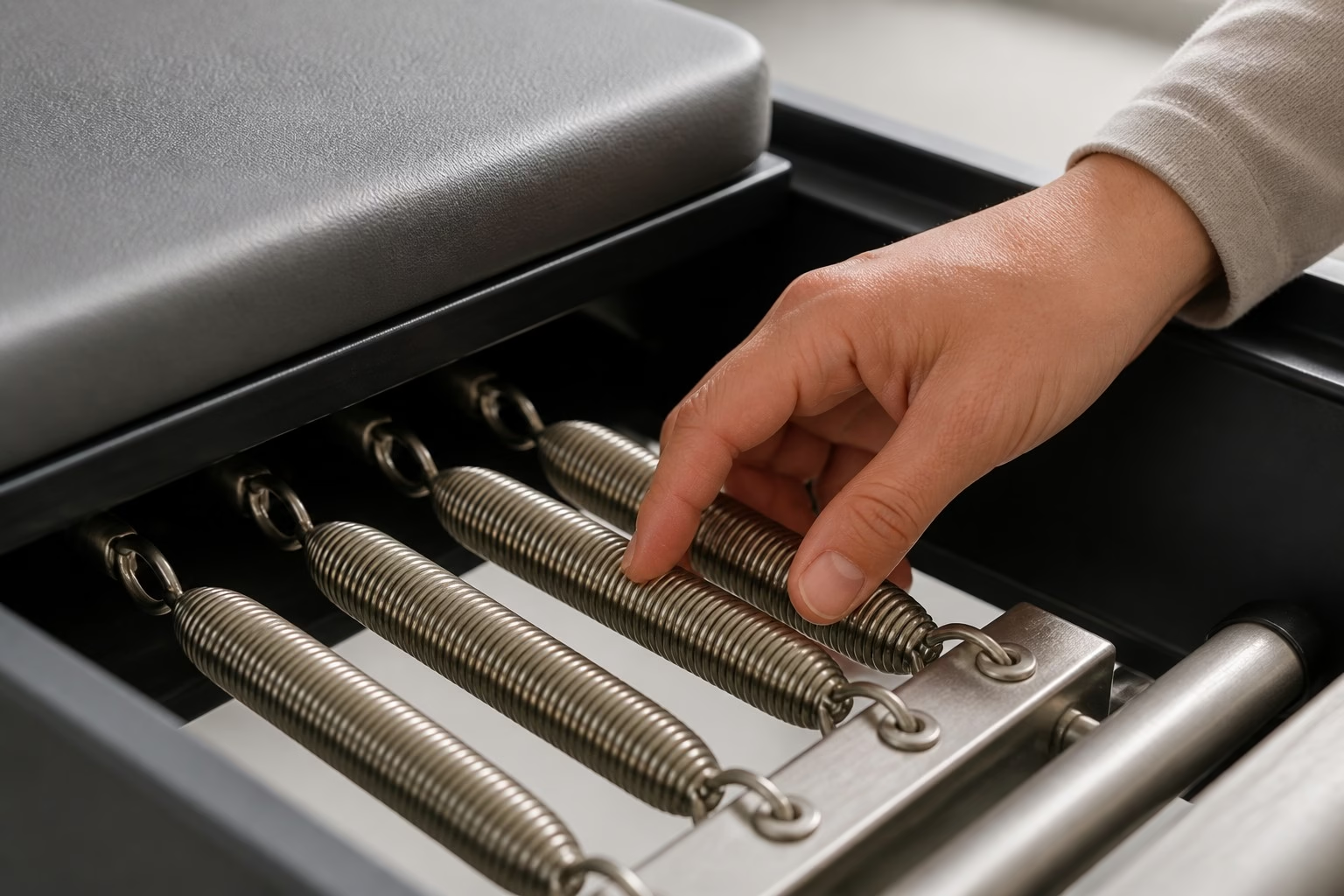
After that it is spares. Reformer springs age, upholstery wears, rollers eventually need replacing. A studio that cannot get a spring set for two months runs classes on tired equipment and clients notice.
Coming back to that Auckland studio. Every individual purchase was defensible. The failure was structural: three suppliers, three lead times, three colour references, and nobody accountable for the room.
One supplier means one lead time, one colour reference, one installation plan, one conversation when something is wrong. It also means the machines were designed to sit next to each other — which is less obvious than it sounds.
This is the part I would push hardest. Photographs and specification sheets cannot tell you what a machine feels like.
Our team is at booth 328, ICC Sydney, on 11 and 12 September 2026 for AusFitness Industry, alongside the wider AusFitness Expo. If you are opening a studio, or replacing a tired row, come and go over one properly:
Bring your floor plan, reference photos, or your equipment list. If you are considering a supply or distribution arrangement, bring that conversation too — we would rather have it face to face than over a quotation template.
Message ahead and we will hold a proper time slot for you. Two days is a short window at a show this size, and a booked 30 minutes beats a rushed five.
If Sydney is not workable, the same conversation runs over a call. Send the floor plan through and we will still draw the room.
Send us your floor plan and tell us the class format you want to run. We will come back with layout options, a 3D visualisation, a complete equipment package and a landed cost — or meet us at ICC Sydney, booth 328, on 11–12 September.

