info@wolsports.com
0086 132 8323 3443
Factory price pilates equipments

info@wolsports.com
0086 132 8323 3443
Factory price pilates equipments
The crates land on a Thursday. Six of them, 245 cm long, sitting on a pallet at the kerb because the truck cannot get closer than the corner. That is the moment a studio owner finds out the building has a 78 cm entrance and a tight turn at the top of the stairs.
I hear that story more often than any question about springs. So before we choose a machine, walk the route. From the kerb to the exact spot where the reformer will stand. Twenty minutes with a tape measure, and it saves a month.
Three things decide how a delivery ends, and none of them are inside your studio.
What can reach the door. A 40 ft trailer needs space to turn and a legal place to stop. On a narrow street with parked cars, the carrier sends a smaller truck, or stops two blocks away and bills you for the difference. Ask what vehicle is booked before delivery day, not on it.
Whether there is a loading dock. A dock means the driver rolls the pallet straight into your building. No dock means a liftgate: the crate is lowered to the road on a platform at the back of the trailer. That platform is narrow, and the driver works alone.
Whether the address is residential. Carriers price residential delivery differently, and a lot of them will not move a pallet past the kerb. Curbside delivery is the default on cheap quotes. It means exactly what it says: the crate stops at the edge of the road.
If your studio sits above a shop on a main road, you probably have a commercial address and a kerb a truck can use. If it sits in a converted house down a lane, assume residential, assume curbside, and plan the last thirty metres yourself.
Take these with a steel tape, not a phone app. Write them down. Send them to your supplier before you pay a deposit.
1. Clear doorway width. Not the frame, the clear opening with the door open at ninety degrees. Our crates run about 65 cm wide and 45 cm tall, so a 70 cm door is theoretically enough. In practice you need hands on both sides, a threshold to lift over, and a 140 kg crate that does not want to go straight. Treat 80 cm as the working minimum and 90 cm as comfortable.
2. Turning radius on the route. Corners are where crates get stuck. Measure the narrowest point, then measure the diagonal you can actually swing a 245 cm box through. A landing that is 1 m deep and 1 m wide will not take a reformer crate around a corner, no matter how strong the crew is.
3. Stair width, headroom and landings. Stair width minus handrail is the number that matters. Then look up: a tight switchback stair often has less headroom at the turn than the crate is tall. Then count landings, because every landing is a place to stop, rest and re-angle the load.
4. The final footprint. A 244 cm machine needs more than 244 cm of wall. Leave at least 60 cm of clearance at the sides for a carriage in motion, and more if the model carries a tower, because the tower adds height and reach.
Most urban studios above the first floor have a goods lift or a freight elevator. Most owners have never measured it.
You need the door opening, the internal depth, the internal height and the rated load. A crated reformer at 90 to 140 kg is not heavy for a goods lift. It is long. A 245 cm crate will not fit in a lift with a 200 cm deep cabin unless it goes in on the diagonal, and the diagonal only works if the door is wide enough to allow the angle.
Two practical points that get missed. Passenger lifts are usually out, not because of weight but because building management will not accept the risk of a scratched door or a jammed crate, and because the crate will not fit anyway. And goods lifts often need to be booked. If the building only releases the lift between 8 and 10 in the morning, tell the carrier before the appointment is set, not after the truck is outside.
Buyers picture a machine. Carriers handle a box.
A fully assembled reformer travels in a plywood crate roughly 245 cm long, 65 to 75 cm wide and around 45 cm high, on a pallet, with the frame braced and the carriage secured. Crated weight for an aluminium studio model runs 90 to 140 kg depending on the frame and the accessories packed with it. A wood reformer is often lighter in the crate than people expect, because the machine itself is around 70 kg and the crate does the rest.
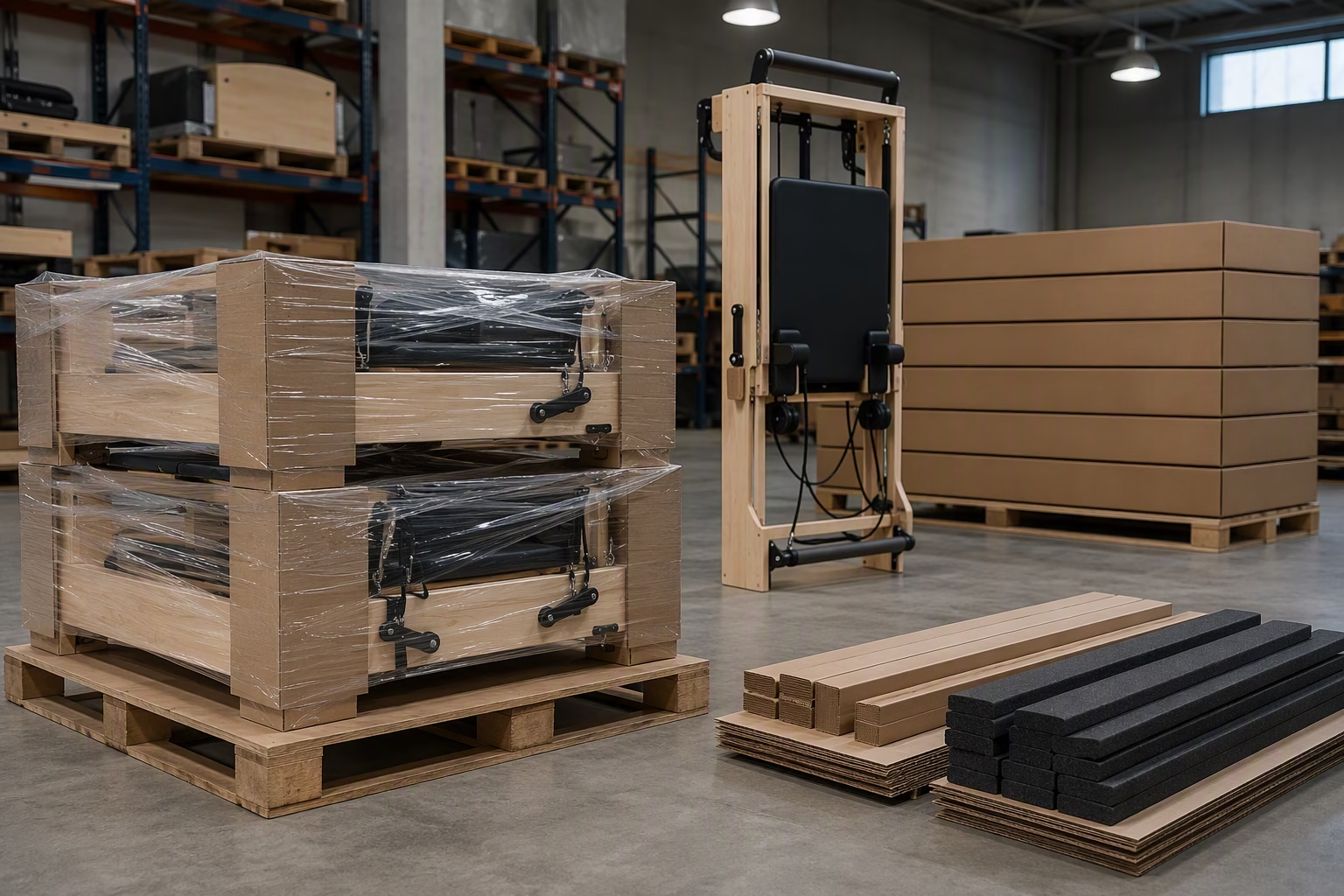
That shape is why the route matters. A 0.7 to 0.8 cbm crate with a 245 cm length behaves like a piano, not like a box of springs. It has one direction it prefers, and every turn on your route either allows that direction or does not.
Ask for the crate drawing in writing, in metres, before you compare quotes. Two factories can quote the same machine and ship crates that differ by 20 cm in height. That 20 cm is the difference between a lift and a stair carry.
Freight quotes are not comparable until you know what happens at the end of the line. Four levels exist, and the price gap between the first and the last is real.
Curbside. The crate is left at the road. You supply the people, the pallet jack and the plan.
Threshold. The crate goes into the building entrance, often just inside the first door. Still crated.
Inside delivery. The crate is placed in the room you name, subject to access. This is the level most studio fit-outs actually need, and the one most buyers forget to ask for.
White glove. Uncrating, placement, assembly, debris removal. Expensive, and worth it when the building has a strict fit-out window or a lift booking you cannot extend.
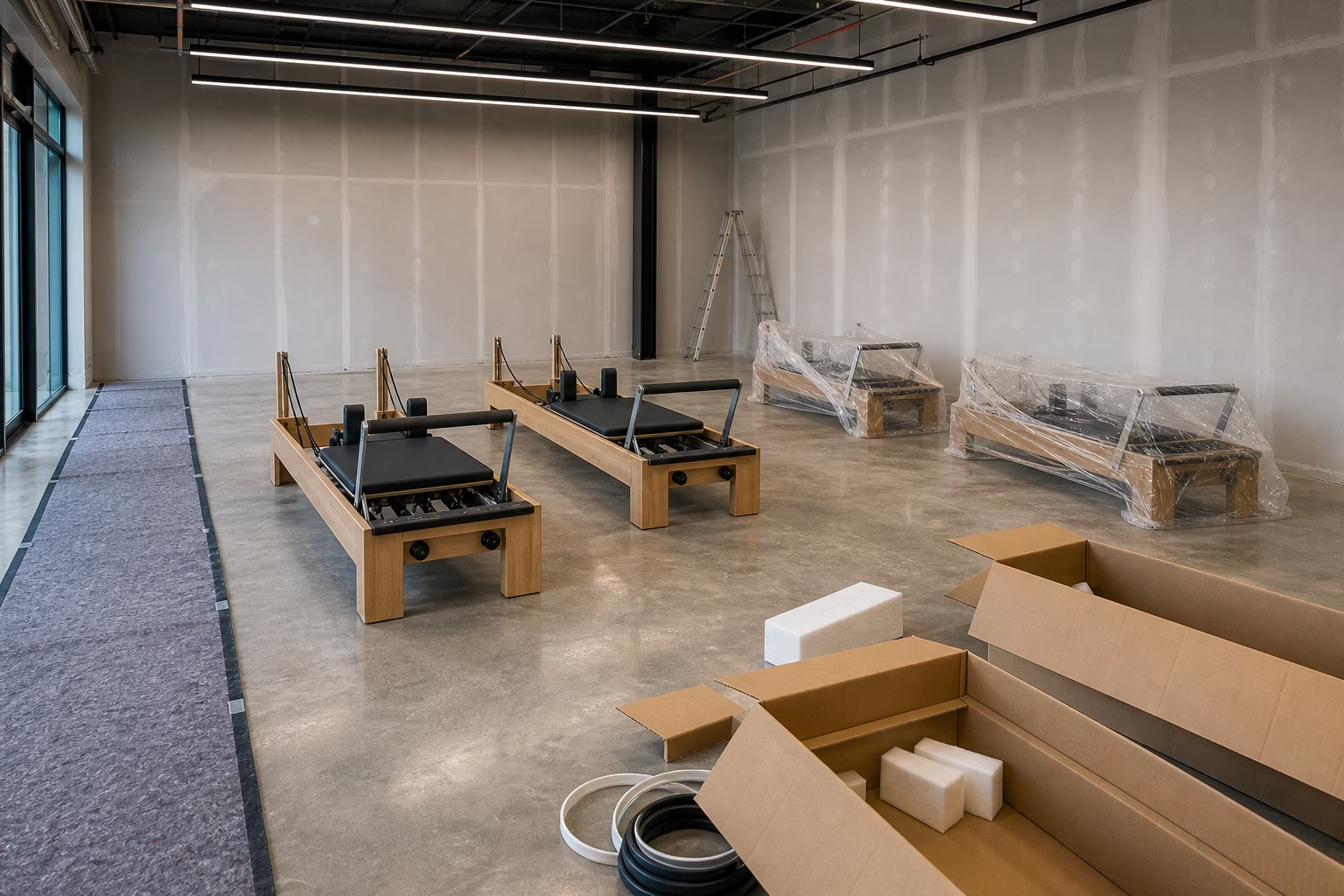
Whichever level you buy, confirm who removes the crate. A studio full of unpacked reformers and a stack of plywood is a fire-safety conversation with your landlord, and plywood does not fit in a passenger lift either.
A freight quote is a base rate plus accessorials. The accessorials are where budgets break, and they are all decided by the facts above.
Residential delivery adds a surcharge. A liftgate adds another. An appointment window, rather than a delivery day, adds another. A redelivery after a missed window costs more than the original delivery. Detention, meaning the driver waiting while your crew finds a pallet jack, is charged by the hour.
Freight class is set by density, and density is set by the crate. Pack tighter, and the class improves. This is one of the few places where a factory decision changes your freight bill after the machine is built, which is why the crate drawing is worth asking for.
Tracking shows where the trailer is. It does not tell you whether that trailer has a liftgate, whether the driver has a pallet jack, whether the appointment was confirmed with your building, or whether the driver will wait while someone finds the keys.
Those four facts live in the delivery instructions, not in the tracking page. Put them in writing when the order is placed: address type, dock or no dock, liftgate required, appointment required, contact name and mobile number that will be answered on the day.
It happens, and it is rarely fatal. There are four ways out, in order of cost.
Change the model. A foldable reformer keeps the 244 cm rail length but folds for storage and transport, and it is the model we recommend when a stair turn is the blocker. A tower model adds height to the crate, so if headroom is the problem, order the reformer and the tower as separate items.
Change the entry. Service corridors, goods entrances and basement loading areas exist in most buildings and are almost never measured by tenants. Ask the building manager before you ask for a crane.
Remove what comes off. Footbars, sitting boxes and towers travel separately in some configurations. A partially knocked-down crate is shorter and lighter, and it costs assembly time at the other end.
Hire a crane or a rigging crew. This is the last option and the most expensive, and it is the one that turns a good margin into a bad week.
We quote faster, and more accurately, when we have these five things:
Clear doorway width. Stair width, headroom and number of turns. Lift dimensions and rated load, if there is a lift. Address type, commercial or residential, and whether a truck can reach the door. The room dimensions and how many stations you plan to run.
With those in hand we can tell you which model fits, what the crate will weigh, and which delivery service level to book. Without them, we are guessing, and so are you.
Measure the route once. It is the cheapest part of opening a studio and the only part that cannot be fixed after the truck arrives.
Send us your doorway width, stair or lift details and the room plan. We will tell you which reformer and which crate fit the route, and what to book with the carrier.

