info@wolsports.com
0086 132 8323 3443
Factory price pilates equipments

info@wolsports.com
0086 132 8323 3443
Factory price pilates equipments
Two things leave an upstairs studio: airborne sound you can stop at the door, and structure-borne impact you cannot. How to tell which one is waking the neighbours, and what to measure before signing the lease.
A studio owner in Melbourne sent me a voice note last month. Six forty in the morning. You hear the room before you hear her: a low thud, then a small metallic tick, then eleven seconds of nothing, then the thud again. That is one footwork series, landing in the flat below like someone knocking politely on a door that is not theirs.
Her neighbour had started keeping a log. Nine entries by the second week. She did not ask me for a quieter machine. She asked the better question. Is this my reformer, or is it my floor?
Almost never one or the other. Two different things leave your studio, and only one of them can be stopped at the door.
Airborne sound is the tick, the spring snap, the wheel running on a dry rail. It travels through the air, through a closed door, and it dies off quickly. A neighbour in the same building hears a muffled version of it and usually ignores it.
Structure-borne sound is the thud. The impact of a moving carriage, a foot on a footbar, a body landing on the carriage goes into the frame, into the feet, into the floor, and then travels through the slab or the joists. It comes out on the other side of the building as a rumble that has almost nothing to do with what you can hear standing next to the machine. This is the one that generates logs.
You can hear the difference yourself. Put a hand flat on the floor next to a foot while someone works the carriage. If you feel the repetition in your palm, the floor is doing the talking.
Every spec sheet lists the machine weight. That number is the least useful one in this conversation.
Static weight is shared across four feet and it does not change. What a floor reacts to is the dynamic load: a client plus a carriage arriving at the end of a spring cycle, plus the return, repeated every few seconds for fifty minutes. A dynamic load is larger than the static weight, and it is applied in one direction, at one spot, in a rhythm. Rhythm is what people notice. Rhythm is what they complain about.
So the useful questions are not “how heavy is it” but “where does the energy go, and how fast does the floor give it back”.
Before anyone blames the building, rule these out. They are cheap to fix and they change the sound a lot.
The wheels and their bearings. A carriage that runs dry, or on a rail with grit on it, produces a hard tick on every pass. Worn bearings turn that tick into a knock. Clean the rail, then listen again. If the noise follows the carriage rather than the floor, you have found it.
The carriage end stop. Some machines catch the carriage on a hard stop. Others use a bumper, a spring, or a longer deceleration. A hard stop puts a sharp impulse into the frame every single repetition, and impulse is the worst kind of energy for a floor to absorb.
Loose hardware and spring hooks. A hook that has opened slightly, a bolt that has worked loose after a move, a foot that is not sitting flat. Each one adds a rattle to the impact and makes the whole thing sound heavier than it is.
If the machine passes all three checks and the log keeps growing, the problem is below the feet, not above them.
Frame material changes the sound, though not in the way most buyers expect.
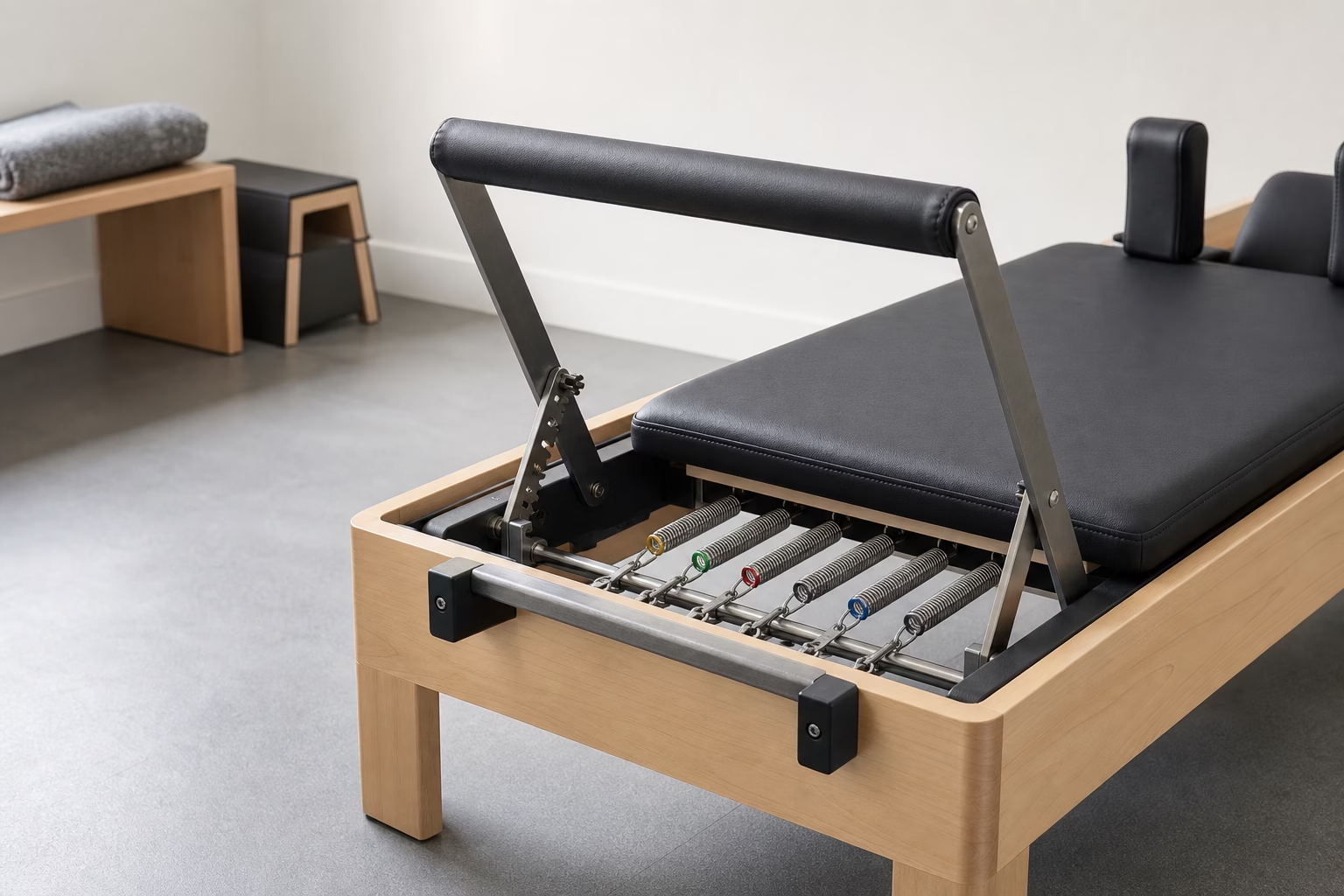
Wood damps. A maple or beech frame absorbs part of the impact inside its own structure, and it tends to produce a lower, shorter thud. It is also heavier, which means more static load and more for two people to carry up a stair.
Aluminium transmits. An aluminium frame is stiffer and lighter, it rings rather than absorbs, and it tends to pass impact straight down into the feet. That is not a defect. It is what the material does. On a concrete slab it makes almost no difference. On a suspended timber floor above someone’s living room, it can.
Neither frame is quiet by itself. If you are fitting out an upper floor above occupied space, the floor build-up matters more than the frame you choose. Our pilates reformer range covers both materials, and the wood models are the ones most often specified for upstairs rooms, for damping reasons rather than marketing ones.
This is where the money is, and none of it is expensive.
Separate the feet from the slab. Rubber crumb mats, cork, or purpose-made isolation pads under each foot break the direct path. A dense mat under the whole machine works better than four small pads, because it spreads the load as well as damping it. A thin yoga mat does nothing. It compresses flat in a week.
Spread the load, then damp it. A plywood plate under the mat distributes the point load across a larger area of floor. Point load is what cracks ceilings and what makes a single foot print through into the room below.
Move the machines off mid-span. A suspended floor is weakest in the middle of a span and stiffest near a wall or a beam. Pulling a row of reformers back towards a structural wall can cut the transfer noticeably. It also gives you a straighter sight line for classes, so nothing is lost.
Keep the noisiest work off the shared wall. Jumpboard, cardio trampoline work, and anything with a landing belongs as far from the neighbour’s wall as the room allows.
Change the schedule before you change the equipment. A 6:30am class in a residential building is a decision, not an accident. If the building has people asleep above you, the first fix may be the timetable.
Six numbers and one conversation.
The conversation is with the tenant below, before you sign. Ask what hours they sleep, and whether they would test a class with you. One session with a borrowed machine and a person standing in the room below tells you more than any specification sheet.
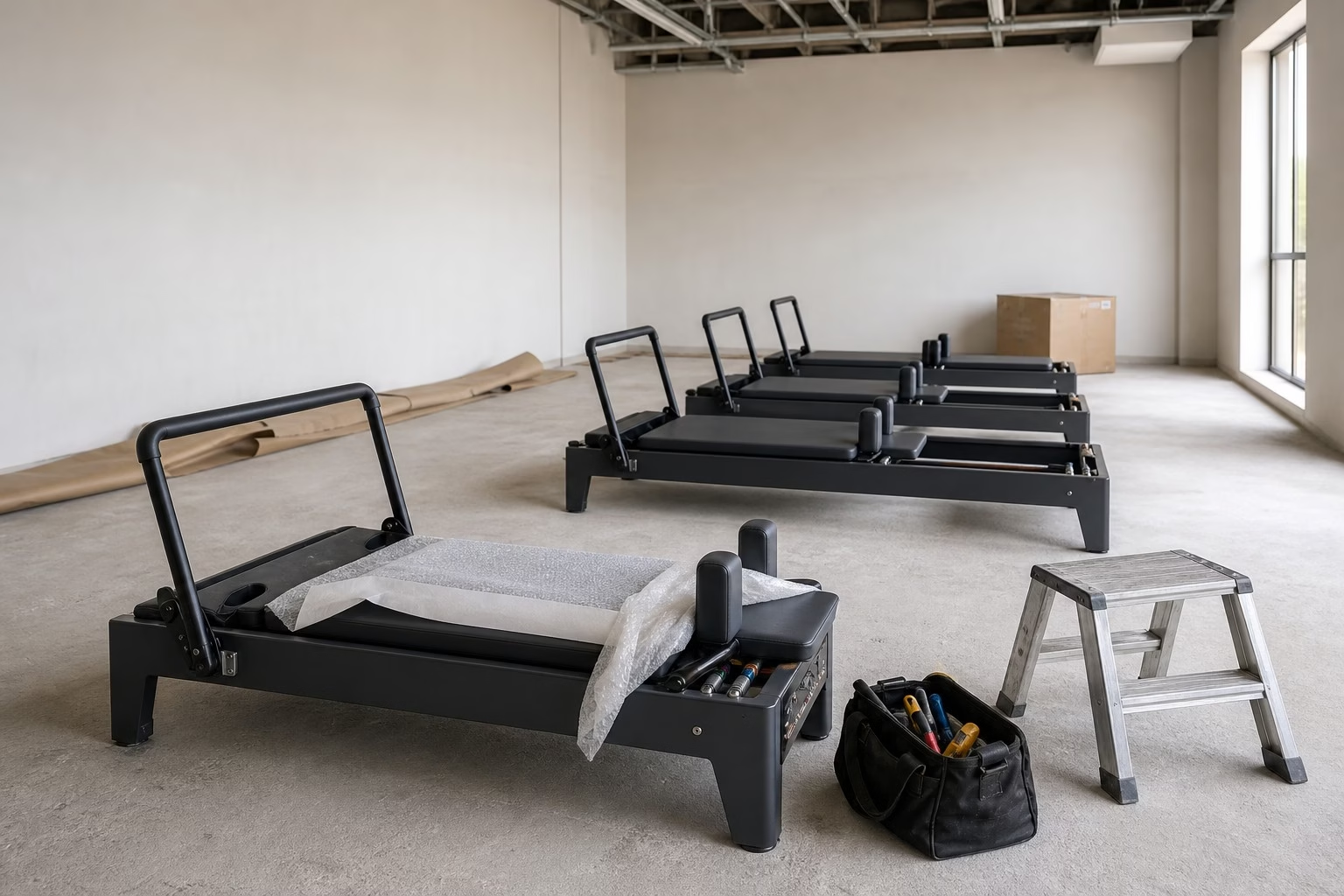
If you are buying for an upper floor, tell the factory that on day one. It changes four things.
Ask for the weight of the machine and the weight of the crate separately. Ask for the footprint and the carriage travel, because two machines with the same footprint can put the impact in different places. Ask whether the feet are fixed or adjustable, and whether a pad can be fitted under them without lifting the frame off the ground. Ask what the wheels and bearings are rated for, since a commercial wheel that stays quiet for five years is worth more upstairs than a cheaper one that ticks in month three.
And ask for a spare spring set in the first order. Not because springs fail early, but because a spring that has lost tension changes the way the carriage returns, and a carriage that returns differently lands differently. Small thing. Audible thing.
If you are running long-platform work, the same questions apply to a megaformer, with one addition: the platform is longer, the arms cantilever, and the machine is heavier. Measure the stairs before you measure the room.
I build reformers. I am not an acoustician, and no factory should sell you a machine as a fix for a floor.
A well-built reformer with clean wheels, a damped frame and a proper mat will be noticeably quieter than a loose one on bare boards. It will not turn a 1970s timber floor above a bedroom into a studio floor. If a supplier tells you their machine solves neighbour noise, ask them what test they ran, in what room, and whether you can see the report.
What we can do is tell you exactly what our machines weigh, where they put that weight, and what has to be true about your room before they arrive. That conversation is free, and it is better had before the deposit than after the first complaint.
Send us your room dimensions, the floor type and the class format. We will tell you which models fit, what they weigh, and what to raise with your landlord before you sign.

